
Where I work with AI.
AI-augmented design
01Research synthesis, concept exploration, workflow modelling, UX copy, accessibility passes, system documentation, and rapid prototyping — with a model doing the volume and me doing the choosing.
Predictive & adaptive UX
02Interfaces that use context to remove work before they add interface — conditional logic, carry-forward, smart defaults, and surfacing the right action at the moment it is needed.
Agentic workflows
03Software that takes multi-step action on someone's behalf, and the interface work that makes that safe: permissions, activity history, pause, and a clear line between reversible and irreversible.
Responsible & explainable AI
04Not an ethics slide — interaction design. Where confidence is shown, where a human signs off, how a correction is made cheaper than a workaround, and what happens when the system is wrong.
AI expands the search space. I make the decisions.
A week of clustering becomes an afternoon. I still read raw transcripts, still ask for the disconfirming evidence, and still keep sample size next to every theme.
When ten structural directions cost what one used to, you stop marrying your first idea. The bar for "did you consider the alternative" goes up.
A model reads component structure far more literally than a person. It counts, finds every detached instance, and drafts documentation. What the system should contain stays a leadership call.
A mockup is an opinion; a working prototype is a finding. Engineering receives a reference implementation instead of a document to interpret.
An AI product in daily use by California law enforcement.
California's Racial and Identity Profiling Act requires agencies to collect detailed stop data on every stop. The question set is fixed by law, officers complete it in the field, and it goes to the state Department of Justice. Existing methods were consuming a large part of a patrol shift.
Displaying output was never the hard part. The hard part was helping a user understand what the system had captured, where it was uncertain, when a human had to review, how to correct it, and how to trust the result in a workflow with legal consequences.
Director of UX Design and Product Manager — both seats. Field research with agencies, translating the DOJ specification into an interface, designing the supervisor review path, and running the roadmap with engineering.
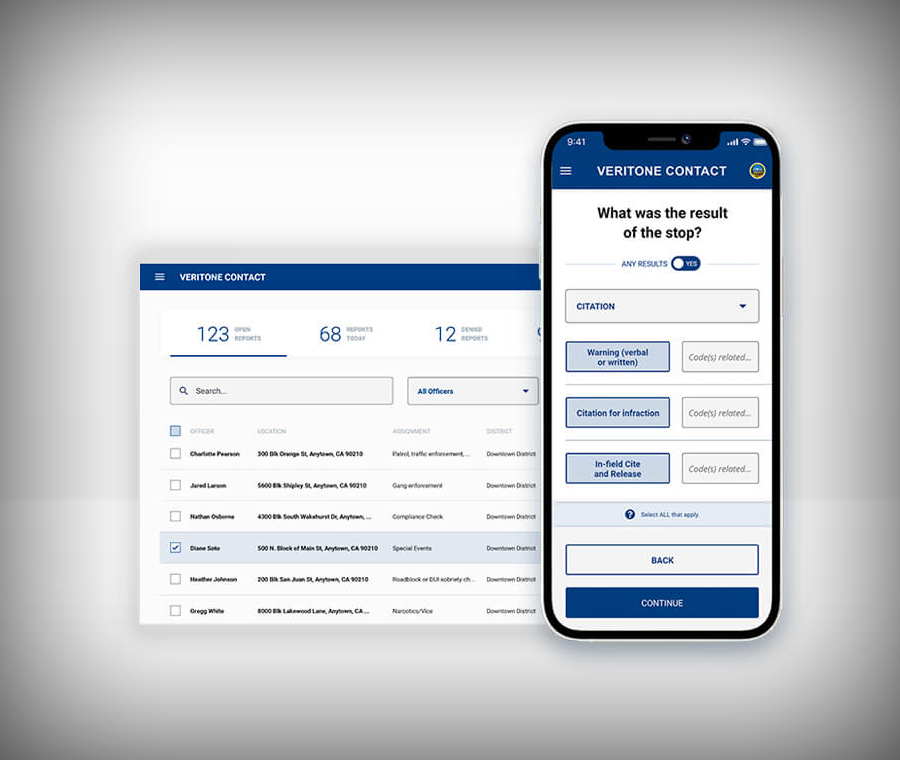
Figures from Veritone's published material. Later releases, including Contact Analytics, shipped after my tenure.
Designing the relationship, not just the interface.
Six questions I answer on every AI feature. Get these wrong and no amount of interface polish saves the product.
Autonomy
How much should it do without asking?
Transparency
Can I understand what happened, in my own language?
Confidence
How certain is the system, and does that change what I should do?
Control
Can I change, stop, or override it at the moment it matters?
Recovery
What happens when it gets it wrong — and is fixing it cheaper than working around it?
Escalation
When does a human take over, and how do they get enough context to act?
Designing for agents, not just for users.
Traditional UX assumes the person performs the action. Agentic software means the person expresses intent and the software does the work. That changes how you design permissions, history, state, explainability, errors, and trust.
Undo is not enough
You cannot undo a sent email or a cleared payment. Some actions need a hold before the consequence, not a reversal after it.
Partial failure is the real design work
An agent that fails silently at step four of seven is worse than one that never ran. What completed, what did not, and what to do about it.
Task, decision, or obligation
Tasks delegate easily. Decisions need a reviewable trail. Obligations with legal or financial weight need a person who can be shown to have signed off.
Reach for the queue, not the chat
The useful precedents are operations tooling and review flows — activity logs, dashboards, approvals — not conversational patterns.
From Figma to working software.
I prototype in real code — production HTML and CSS by hand, and AI-assisted builds for anything larger. It lets me test behaviour early and give engineering something that runs instead of asking everyone to interpret static screens.
Code has become another design medium rather than something that happens after handoff.
<section class="stop-review">
  <header>
    <h2>Review before submission</h2>
    <p class="meta">3 people · 1 stop</p>
  </header>

  <ol class="people">
    <li data-state="needs-review">
      Person 1 <button>Correct</button>
    </li>
    <li data-state="verified">Person 2</li>
    <li data-state="verified">Person 3</li>
  </ol>

  <button class="primary" disabled>
    Submit to DOJ
  </button>
</section>
Organised by what it is for.
ChatGPT
Figma AI · FigJam
HTML · CSS · JS
APIs · agents
The tools will change — most of this list did not exist in its current form two years ago. The workflow and the judgment are the part worth hiring.
Building an AI product where trust, autonomy, and craft actually matter?
I'm interested in Head, Director, VP, Staff, and Principal roles where AI changes the product itself — not only the workflow used to design it.